Why Buying Generic Lead Lists Is a Waste of Money?
If you run a business in the United States or Canada and you’ve ever typed “buy lead lists” into Google, you already know the pitch: thousands of contacts for a few hundred dollars, delivered instantly, ready to plug into your CRM. It sounds like a shortcut to growth.
It isn’t. It’s one of the fastest ways to burn your marketing budget, damage your sender reputation, and waste your sales team’s time on prospects who were never going to buy from you in the first place.
Here’s why generic lead lists fail — and what actually works instead.
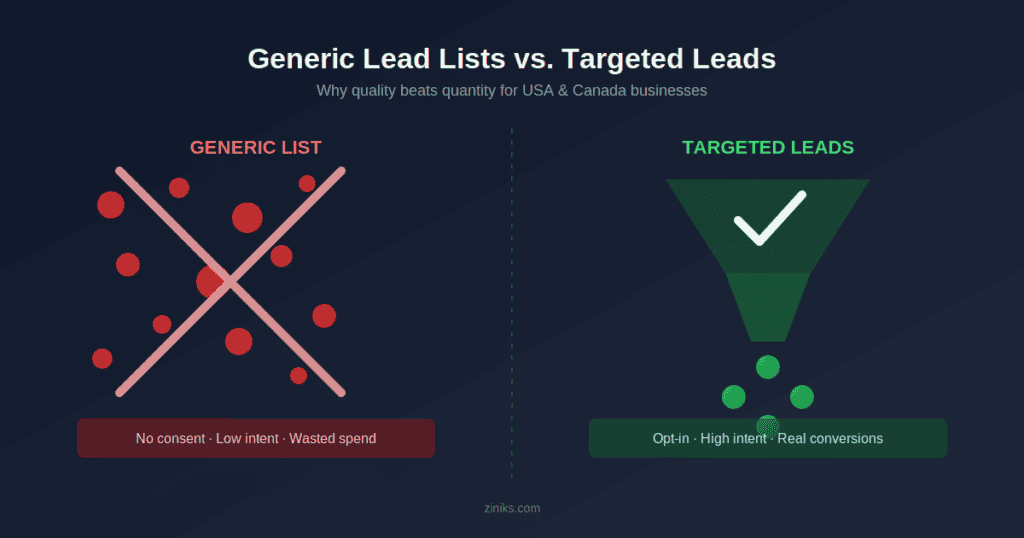
What “Generic Lead Lists” Actually Are
A generic lead list is a bulk export of names, emails, and phone numbers scraped or compiled from public directories, old databases, or third-party data brokers. They’re usually sold by industry, job title, or geography — “5,000 CEOs in North America” or “10,000 homeowners in Texas.”
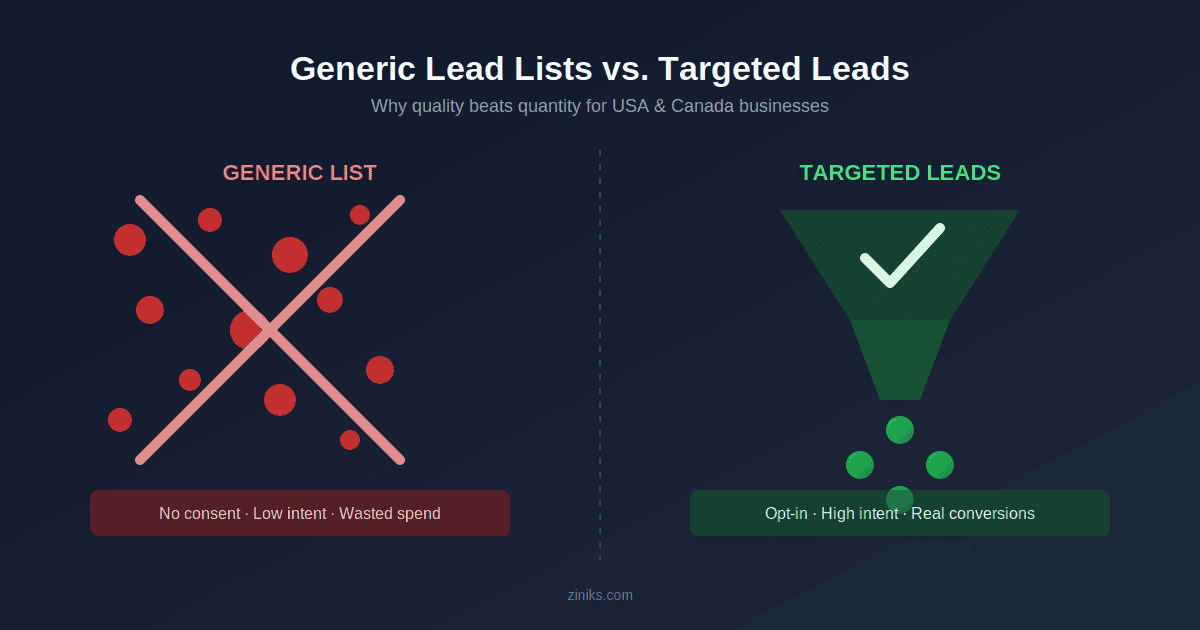
The problem is right there in the description. These lists are built for volume, not relevance. Nobody on that list asked to hear from you. Most of them have never heard of your company, your product, or your offer.
1. The Data Is Outdated the Moment You Buy It
People change jobs, phone numbers, and email addresses constantly. Studies on B2B data decay consistently show that databases degrade by roughly 20–30% per year. A list that was accurate when it was compiled six months ago could already have a third of its contacts bounced, retired, or irrelevant by the time you use it.
In the US and Canada specifically, job mobility is high and email providers are aggressive about filtering unfamiliar senders — which brings us to the next problem.
2. It Wrecks Your Email Deliverability
When you email a purchased list, a predictable chain of events follows:
- A high percentage of addresses bounce because they no longer exist.
- Recipients who don’t recognize your name mark you as spam.
- Email providers like Gmail, Outlook, and Yahoo notice the pattern and start routing all your future emails — even to real subscribers — straight to spam.
This is especially costly for USA and Canada-based businesses, since Gmail and Microsoft dominate the inbox market in both countries. One bad blast to a purchased list can quietly tank your deliverability for months.
3. It’s a Compliance Risk (CAN-SPAM and CASL)
This is the part most people skip past — and it’s the most expensive part if you get it wrong.
- In the United States, the CAN-SPAM Act requires clear opt-out mechanisms and prohibits misleading sender information. Purchased lists rarely include verifiable consent.
- In Canada, Canada’s Anti-Spam Legislation (CASL) is stricter still — it generally requires express or implied consent before you can send commercial electronic messages at all. Blasting a bought list to Canadian contacts without consent can trigger fines that run into the tens of thousands of dollars per violation.
A generic list gives you no proof of consent, no opt-in trail, and no legal safety net. You’re not just wasting money — you’re taking on legal exposure.
4. Low Intent Means Low Conversion
Even when the data is technically accurate, purchased leads have never expressed interest in what you sell. They didn’t fill out a form, download a resource, or engage with your brand in any way. You’re cold-contacting a stranger and hoping timing works in your favor.
Compare that to a lead who filled out a Facebook Lead Ad, requested a quote, or downloaded a guide from your site. That person raised their hand. They’re already warm. Industry benchmarks routinely show inbound, opt-in leads converting at several times the rate of purchased-list leads — because intent, not volume, drives revenue.
5. It Damages Your Brand Reputation
Unsolicited outreach to people who never asked for it doesn’t just fail to convert — it actively creates negative impressions. In tight-knit industries and professional networks common across the US and Canada, a bad first impression from a cold, irrelevant pitch can follow your brand for years.
What to Do Instead: Build Targeted, Consent-Based Lead Generation
The good news is that better lead generation isn’t harder — it’s just more intentional. Here’s what consistently outperforms bought lists:
Run Targeted Ad Campaigns
Platforms like Facebook and Instagram Lead Ads let you target by location (down to the city or province), interests, and behavior — so every lead comes from someone who already fits your ideal customer profile in the US or Canada market you care about.
Capture Leads With Real Opt-In Forms
A simple landing page offering something valuable — a quote, a checklist, a discount — converts strangers into consented, trackable leads. This alone solves your CASL and CAN-SPAM compliance problem, because you have a documented opt-in.
Automate the Follow-Up, Not the Acquisition
Once a lead opts in, automation tools can route that lead instantly to your CRM, sales team, or email sequence — so speed-to-lead (which is proven to dramatically affect conversion rates) stops depending on manual work.
Nurture Before You Sell
Warm leads convert better with a short nurture sequence — a few emails or messages that build trust — rather than an immediate hard pitch.
The Bottom Line Why Buying Generic Lead Lists Is a Waste of Money?
Generic lead lists look cheap upfront, but the real cost shows up later: wasted ad and sales spend, damaged email deliverability, legal exposure under CAN-SPAM and CASL, and a sales team chasing contacts who were never going to buy.
Targeted, consent-based lead generation costs more effort to set up — but every lead it produces is real, trackable, and already interested. In the long run, that’s not just more ethical. It’s more profitable.
Why Buying Generic Lead Lists Is a Waste of Money becomes clear when businesses realize that most generic lead lists contain outdated, inaccurate, or irrelevant contact information. Instead of reaching potential customers, companies waste valuable time and marketing budgets on leads that rarely convert into real sales.
Another reason Why Buying Generic Lead Lists Is a Waste of Money is that these lists are not targeted to your ideal audience. High-quality, niche-specific leads generate better engagement, higher response rates, and stronger ROI compared to generic databases that lack proper verification and segmentation.
Understanding Why Buying Generic Lead Lists Is a Waste of Money helps businesses make smarter marketing decisions. Investing in verified, industry-specific lead generation services ensures higher-quality prospects, improved email deliverability, and better long-term business growth while reducing wasted marketing expenses.
Why buying generic lead lists is a waste of money?
Generic lead lists often contain outdated, inaccurate, or irrelevant contacts. This leads to low response rates, wasted marketing budgets, and poor ROI compared to verified, targeted lead lists.